What's the difference between cited, mentioned, and recommended in AI search?
Updated November 2026
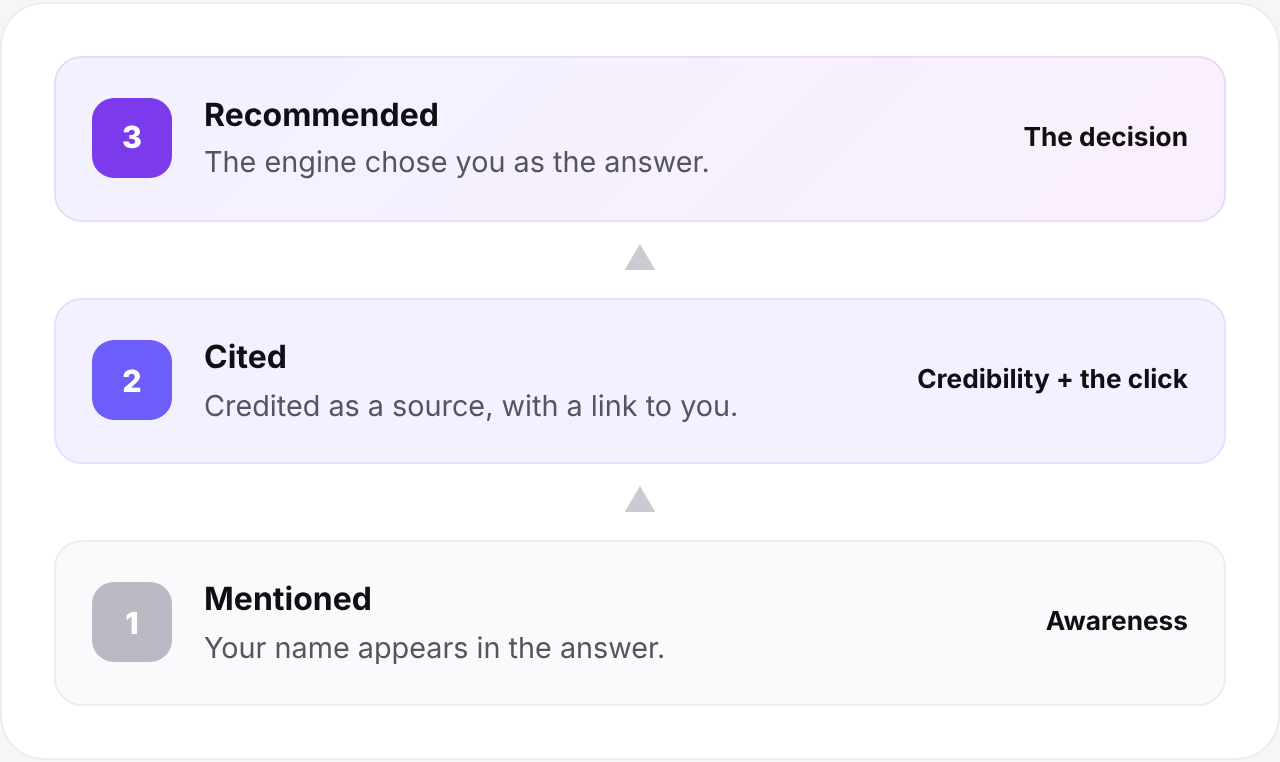
In AI search, a mention is when an engine names your brand in its answer. A citation is when it credits your content as a source and links to it. A recommendation is when it puts you forward as the answer to a buying or comparison question. They form a ladder: mentioned means the engine knows you exist, cited means it trusts you enough to source you and send the click, and recommended means it chose you. Only a citation reliably sends a visitor to your site, and recommendations cluster on the questions with money behind them.
The three, defined
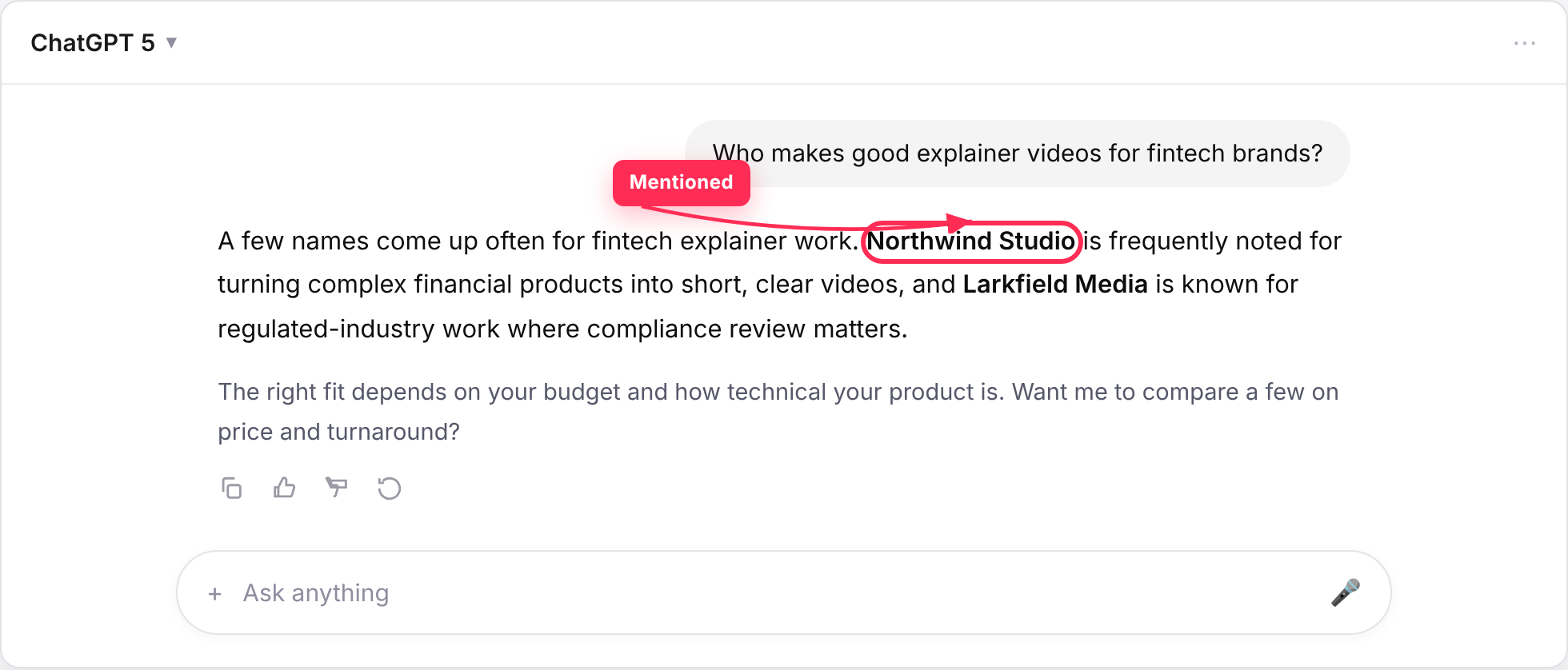
Mentioned. Your brand name appears in the generated answer, with no link and no credit to your content. A mention builds category association. It tells you the engine knows your name in this topic. It does not, on its own, send traffic or prove the engine trusts a page you own. Most mentions are earned by what other sites say about you, not by your own pages: in one analysis, about 85% of brand mentions in AI answers came from third-party pages rather than brand-owned content (AirOps).
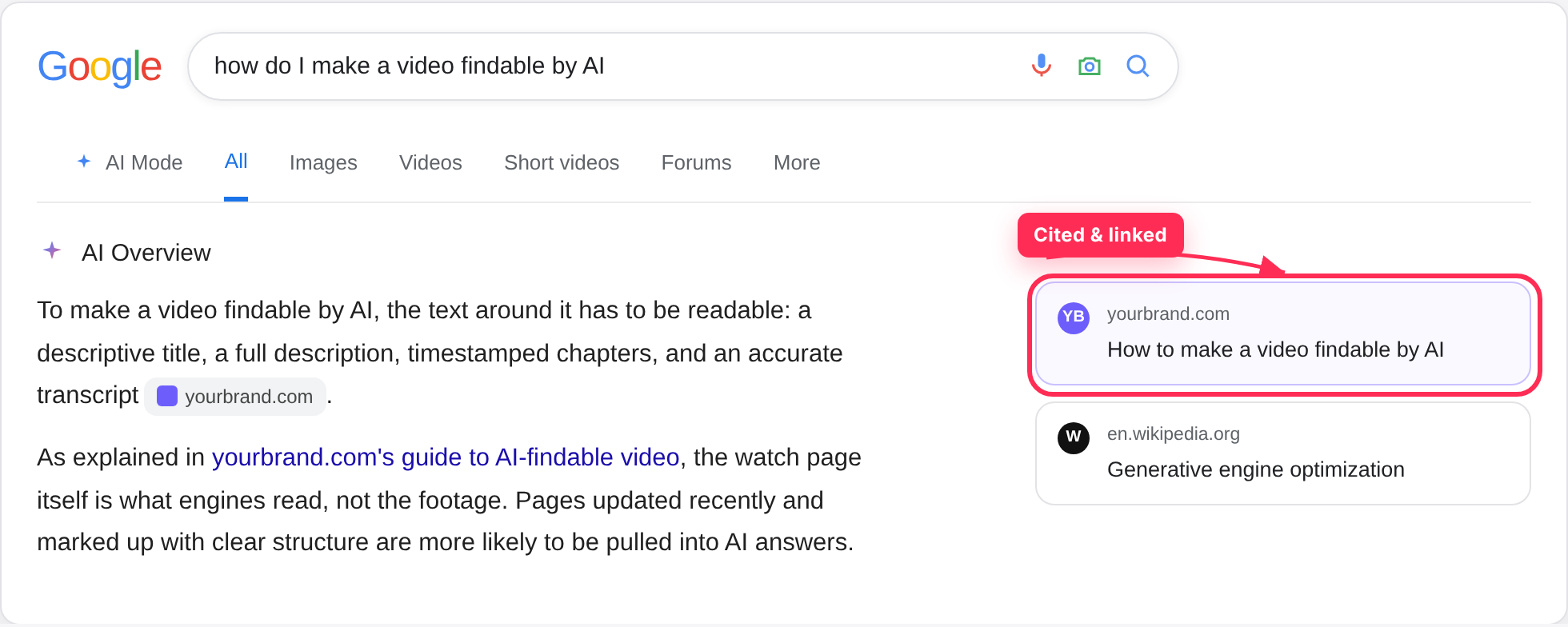
Cited. The engine credits your content as the source of a claim and links to it, as a numbered footnote, an inline link, or a source card. A citation is the one that sends a visitor to you, and it signals that the engine treated your page as authoritative enough to stand behind. It is also where you own the path: the click lands on a domain you control. In our testing this is the metric that moves a buyer, because the reader can act on it.
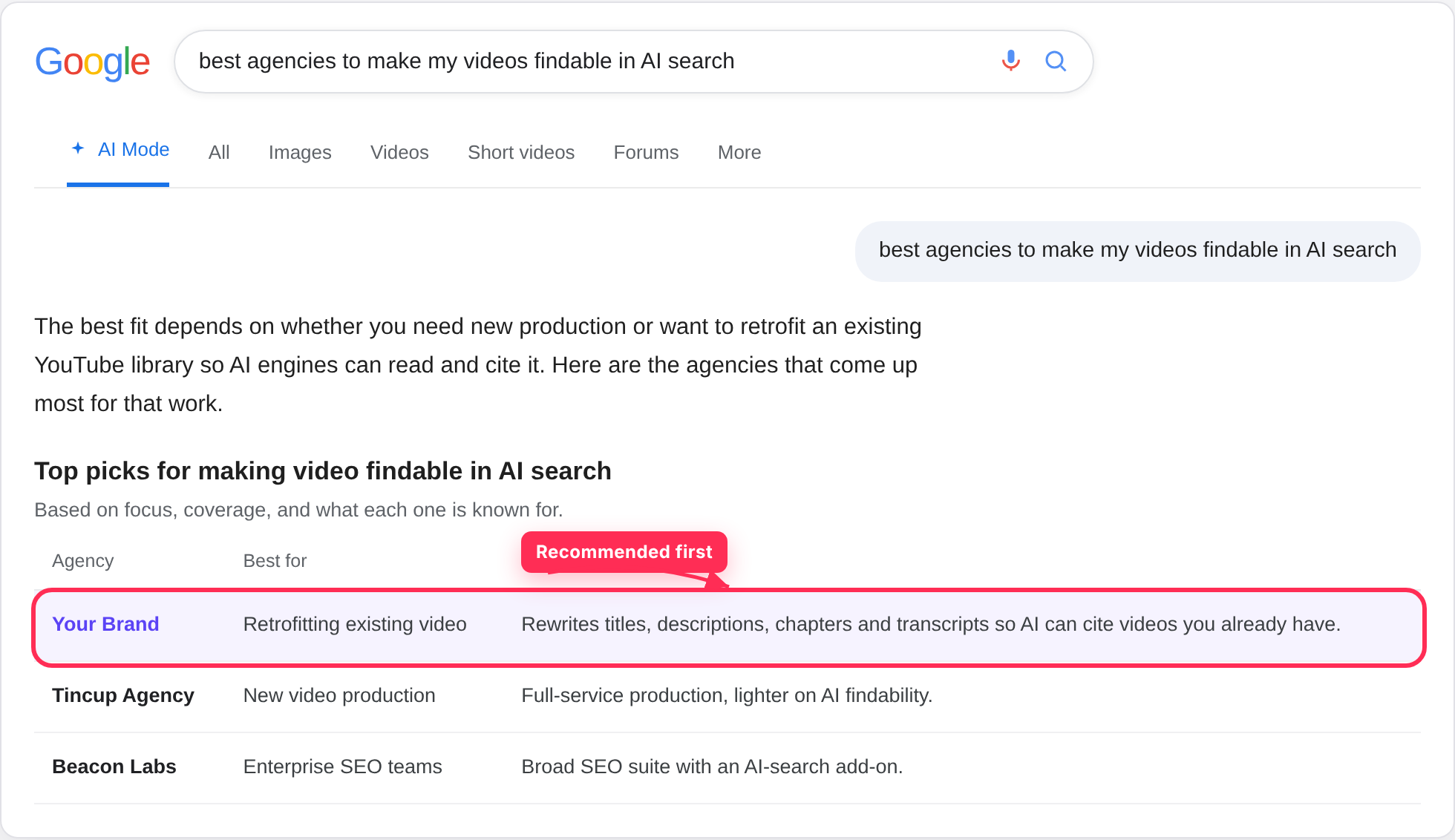
Recommended. The engine does not just name you or source you, it advances you as the answer. This shows up most on comparison and buying questions, where the model returns a short list of brands or a single suggested choice. Being on that list, or being the one it names first, is the closest thing AI search has to a recommendation. It is the hardest to earn and the most valuable, because the question already carries intent.
The three at a glance
| Mentioned | Cited | Recommended | |
|---|---|---|---|
| What it is | Your name appears in the answer | Your content is credited as a source, with a link | You are advanced as the answer or on the shortlist |
| What it looks like | Plain brand name in the text | Footnote, inline link, or source card | A ranked list or a named first choice |
| Sends a visitor? | No, on its own | Yes, this is the one that does | Yes, and the visitor arrives with intent |
| What it proves | The engine knows you in this topic | The engine trusts a page you own | The engine chose you for a decision |
| Where it shows up most | Any answer | Informational and research answers | Comparison and buying answers |
| Who controls the source | Mostly third-party pages | Often a page you own | A mix, shaped by what gets cited |
Why the distinction matters
If you only count whether your name appears, you will overstate where you stand. A brand can be mentioned often and cited rarely, which means it is known but not trusted as a source, and it earns no path to a visitor. The three also behave differently across the funnel. A mention is awareness. A citation is credibility and the click. A recommendation is the decision. That maps to why they are worth measuring separately rather than as a single "AI visibility" number.
The gap between mentioned and cited is real and large. Being named is common; being credited with a link is not, and the two do not move together. Earning both a mention and a citation in the same answer makes a brand meaningfully more likely to keep showing up on that topic in later answers (AirOps reports about 40% more likely), which is why the goal is not one or the other but both, pointed at the same questions.
What the data says in 2026
AI answers increasingly sit between your buyer and your site, and they absorb the click. In a Pew Research Center study that tracked about 69,000 Google searches from 900 US adults in March 2025, an AI summary appeared on roughly 18% of searches, and when one did, people were markedly less likely to click: 26% ended their session without clicking anything, versus 16% when there was no summary, and only 1% clicked a link inside the summary itself. The takeaway for this topic: if you are only mentioned, you sit inside the answer that replaced the click, with no way to collect the visit.
Where you show up is not the same from one engine to the next. In an Ahrefs study of 15,000 prompts, only about 12% of the pages cited by ChatGPT, Gemini, and Copilot also appeared in Google's top ten results, and the engines diverged sharply from each other: Perplexity overlapped Google's results about 29% of the time, the others closer to 8%. Being cited in one place says little about another, which is why we measure each engine separately.
You can influence citations more than mentions, because citations lean on pages you control. Yext's analysis of 6.8 million AI citations found about 86% came from brand-managed sources such as your own site and listings. Mentions are mostly the reverse, earned on third-party pages you do not control, which is why citations are the more directly winnable of the two. The goal is both, earned on the same questions.
The visitors who do arrive from AI answers tend to be high intent. In one analysis of 94 ecommerce sites, ChatGPT referral traffic converted about 31% better than non-branded organic search. That intent concentrates in the recommendation tier, where buying questions get decided, and it behaves differently on every engine.
How video fits
Most of this is usually discussed as a website problem. For video it is sharper, because the most-cited source in AI answers is the one most brands already own and leave unreadable. YouTube is the single most-cited domain in Google's AI Overviews, at roughly a 29.5% share in one BrightEdge analysis. A video that answers a buyer's question can be mentioned, cited, or recommended, but only if the text around it, the title, description, chapters, transcript, and watch page, is readable by the engine. Fix that text layer and a video you already made becomes something AI can cite and put forward, not just walk past.
How we measure these three
Because the three are different outcomes, we score them separately rather than rolling them into one number. In our testing we run a fixed set of the questions your buyers actually ask, across ChatGPT, Gemini, and Google's AI Overviews, and we sample each question several times because answers vary between runs. We report mention rate (how often your brand is named), citation share (how much of the cited source material is yours), and, on the comparison and buying questions, whether you are recommended at all. Measuring them apart is what shows you the real gap: known but not cited, or cited but never the recommendation.
Where you stand
The free AI Findability Score tells you how readable your videos are to the engines that do the citing. The paid baseline goes further and measures, question by question, whether you are mentioned, cited, or recommended today, and who holds the answer instead.
Get my free AI Findability Score →
Frequently asked questions
Is a mention worth anything if there is no link?
Yes, but less than it looks. A mention builds category association and often precedes a citation, and earning both together makes you more likely to keep appearing on that topic. On its own it sends no traffic and does not prove the engine trusts a page you own.
Which one should I optimize for first?
Citations, because they are the rung you can most directly influence (they lean on pages you control) and they are the one that sends a visitor. Recommendations tend to follow once you are consistently cited on the questions that matter.
Why am I cited in ChatGPT but not in Perplexity, or the reverse?
Because the engines pick sources differently and overlap surprisingly little. In one study of 15,000 prompts, only about 12% of the pages AI engines cite also appeared in Google's top results, and the engines diverged from each other too. Being cited in one is not evidence about the others, which is why we measure each engine separately.
Does being cited guarantee a recommendation?
No. Citations are about being a trusted source for a claim; recommendations are about being advanced as the choice, usually on comparison and buying questions. You can be cited often on informational questions and never recommended on the ones with money behind them, which is exactly the gap worth finding.
How often does this change?
Often. Answers for the same question vary between runs, and the mix of sources an engine cites shifts over time, so a single check is a snapshot. That is why we sample repeatedly and re-measure on a schedule.